Table of Contents
ToggleBuilding a tiny Minecraft house doesn’t mean settling for cramped, uncomfortable spaces. In fact, compact builds force players to think strategically about every block placement, leading to some of the most creative and efficient designs in the game. Whether a player is starting fresh in survival mode with limited resources or challenging themselves to build within a tight footprint, tiny houses offer surprising versatility. This guide covers essential design principles, beginner-friendly builds, and advanced techniques to help players maximize every square block of their compact Minecraft homes.
Key Takeaways
- A tiny Minecraft house conserves early-game resources while providing full functionality with just a 5×5 or 7×7 footprint that fits a bed, crafting table, furnace, and storage.
- Vertical building is critical for compact designs—a two-story 5×5 house provides 50 blocks of floor space compared to only 25 in a single-story version, maximizing usable area.
- Tiny Minecraft house designs benefit from multi-functional blocks like barrels, trapdoors, and slabs that serve dual purposes as both functional items and decorative elements.
- Hidden storage solutions such as barrel walls, shulker box organization, and under-floor chests keep interiors clean and spacious without consuming visible living area.
- Advanced builders can push tiny house efficiency further with vertical tower homes, redstone automation, camouflaged builds, and modular expandable designs that grow organically with gameplay progression.
- Strategic window placement, varied textures, and height-distributed lighting prevent compact spaces from feeling claustrophobic while adding visual depth to small rooms.
Why Build a Tiny Minecraft House?
Tiny Minecraft houses serve multiple practical purposes beyond the aesthetic challenge. For survival mode players, a compact starter home conserves precious early-game resources like wood, cobblestone, and glass while still providing full functionality. A 5×5 or 7×7 footprint can comfortably house a bed, crafting table, furnace, and basic storage without requiring stacks of materials.
Smaller builds also fit naturally into tight terrain features, tucked into hillsides, perched on cliff edges, or nestled between trees, without requiring extensive landscaping or terraforming. This reduces build time and preserves the natural environment, which many players prefer for immersive gameplay.
From a gameplay perspective, tiny houses encourage intentional design. Every block must earn its place, forcing builders to prioritize essentials and discover creative space-saving storage solutions that translate well to larger projects. Players who master compact building develop stronger spatial planning skills that improve all their future builds.
Finally, tiny houses work exceptionally well for multiplayer servers where claim space is limited or for players maintaining multiple bases across different biomes. A well-designed tiny house can be replicated quickly, allowing players to establish functional outposts without major time investment.
Essential Design Principles for Compact Minecraft Builds
Effective tiny house design in Minecraft relies on maximizing vertical space and eliminating dead zones. Vertical building is critical, a two-story 5×5 house provides 50 blocks of floor space versus 25 in a single-story version. Loft sleeping areas accessed by ladders or compact staircases free up ground-level space for functional workstations.
Multi-functional blocks dramatically improve efficiency. A crafting table can double as a kitchen counter. Barrels provide storage while serving as decorative elements or seating. Trapdoors, when placed strategically, act as tabletops, ladder rungs, or decorative shutters. Slabs and stairs add visual interest while creating usable surfaces at half-block heights.
Hidden storage keeps interiors clean and spacious. Floors can incorporate barrel storage accessed from below in a basement level. Wall-mounted item frames hold essential tools without consuming floor space. Ender chests provide access to shared storage without requiring multiple large chest arrays.
Light management prevents tiny spaces from feeling claustrophobic. Place light sources, torches, lanterns, or sea lanterns, at multiple heights to eliminate shadows. Glass blocks or panes for walls and ceilings create an open, airy feel while maintaining protection. Strategic window placement frames exterior views, making interiors feel larger.
Color and texture variation adds depth to compact spaces. Mixing wood types, incorporating stone accents, or adding plant blocks (leaves, vines, potted flowers) creates visual complexity that makes small rooms feel more detailed rather than sparse. Similar to techniques used in real-world tiny home design, contrast between materials defines functional zones within open floor plans.
Top 5 Tiny Minecraft House Designs for Beginners
These beginner-friendly designs require minimal materials and basic building skills while delivering fully functional survival homes.
Simple Starter Cabin
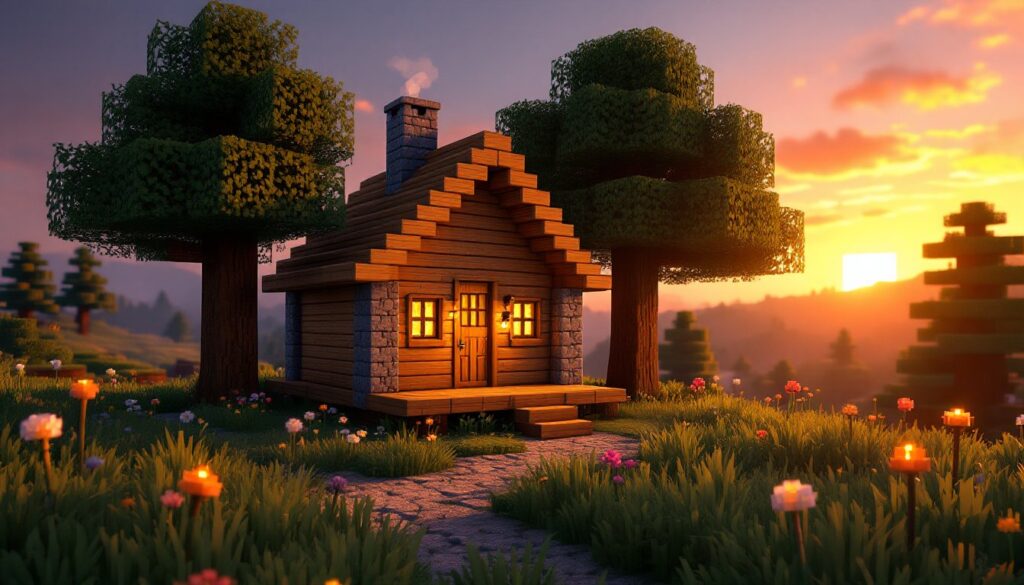
The 5×5 cabin is the quintessential survival starter home, requiring only 100 blocks of wall material (typically oak planks or cobblestone), 25 blocks for the floor, and about 40 blocks for a simple gabled roof. The ground floor accommodates a bed, crafting table, furnace, and four barrels for storage.
Construction takes 10-15 minutes. Frame the walls with full-height blocks, leaving a 2-block-high doorway on one side and space for 2-4 windows (use glass panes to save materials). Add a second floor using a half-slab ceiling at 3 blocks high to create a crawl-space loft for the bed, accessed by a ladder. This frees the ground floor for crafting and storage.
Place torches on walls rather than floors to maximize usable space. A single door is adequate, but adding a trapdoor window above the door improves ventilation and light. This design works in any biome and uses materials available within the first hour of gameplay.
Underground Hobbit Hole
The hobbit hole excavates into a hillside rather than building up, saving exterior materials almost entirely. Find a hill with at least 4-5 blocks of vertical rise. Dig horizontally 5-7 blocks deep and 5-7 blocks wide, creating a rounded or rectangular chamber.
The entrance requires a door and frame (6 planks plus hardware), but walls, floor, and ceiling are natural dirt or stone, requiring no additional blocks. Players can leave walls natural for a rustic look or line them with wood planks collected during excavation of the entry tunnel. Many DIY builders appreciate the resource efficiency, no materials wasted on exterior walls.
Windows present a challenge but aren’t impossible. Excavate window alcoves that open through the hillside, or add a skylight by removing ceiling blocks and replacing them with glass. Internal layout follows the same principles as the starter cabin: bed, crafting table, furnace, storage.
One safety note: ensure the roof has at least 3 blocks of solid material above the ceiling to prevent mob spawning overhead. Mark the roofline with torches or fences on the hill surface to avoid accidental cave-ins during future terraforming.
Advanced Tiny House Ideas for Experienced Builders
Experienced builders can push compact design further with these advanced concepts that maximize functionality per block.
The Tower Home builds vertically in a 3×3 or 4×4 footprint across 4-5 floors. Each floor serves a dedicated function: ground floor for entry and storage, second floor for crafting and smelting, third floor for enchanting, fourth floor for sleeping, and roof access for farming or lookout. Spiral staircases or central ladder shafts connect levels. This design requires careful planning of ladder positions to avoid blocking functional areas.
The Redstone Compact integrates hidden redstone mechanisms for space-saving automation. Piston doors eliminate the 2-block door frame requirement. Hopper systems beneath floors automatically sort items from a single chest input. Redstone lamps controlled by daylight sensors provide automatic lighting without placing multiple torches. Hidden lever or button controls keep walls clean. This build demands understanding of redstone basics but results in a highly efficient space.
The Camouflaged Build disguises the house as natural terrain. A 6×6 structure built entirely within a large spruce or oak tree uses leaf blocks for exterior walls with small glass panel windows. Alternatively, building inside a hollowed-out desert hill with sandstone walls creates an invisible base. The exterior shows no signs of player activity while providing full interior functionality. Entry might be through a hidden piston door activated by a specific block interaction.
The Modular Expandable starts as a 5×5 core but features attachment points for 3×3 or 4×4 extensions. The initial build contains only essentials, but as players gather resources, they add specialized rooms: enchanting library, potion brewing station, nether portal chamber. Each module connects via short hallways or doorways, allowing the tiny house to grow organically without demolishing the original structure.
The Floating Island Micro-Home suspends a 4×4 or 5×5 structure on pillars or chains above ground level. This design works exceptionally well in swamp biomes or over water, providing natural mob protection while consuming minimal ground space. Access via ladder or staircase. The elevated position offers strategic visibility and can be expanded downward into underwater or underground sections as needed.
Space-Saving Storage Solutions for Your Tiny Minecraft Home
Storage often becomes the limiting factor in tiny house functionality. These solutions maximize item storage without consuming excessive floor space.
Barrel walls replace traditional chest arrays. Barrels can be placed directly adjacent to each other and accessed from any side, unlike chests which require space above them to open. A 3-block-high wall of barrels provides 21 storage slots (63 total inventory spaces) in just one block of floor depth. Arrange barrels in patterns using different wood types to create visual interest while maintaining full functionality.
Shulker box organization condenses storage dramatically. A single chest holding 27 shulker boxes provides access to 729 item slots. Color-code boxes by category: red for redstone components, blue for building blocks, green for food. This system works particularly well for tiny houses where a single chest can serve as a comprehensive storage system.
Vertical storage towers use hoppers and chests in vertical configurations. A 4-high tower of chests accessed by ladders stores 108 item slots in a 1×1 floor footprint. Place ladders on the side of the chest column for easy access to each level. This works especially well in corners or along back walls.
Ender chest networks eliminate the need for multiple storage chests. A single ender chest placed in the tiny house accesses the same 27-slot inventory available from any other ender chest the player places. For players with multiple bases, this provides instant access to essential items without physical storage requirements at each location.
Hidden floor storage excavates one block below floor level and places barrels or chests in the cavity, covered with trapdoors that serve as the walking surface. This entirely hidden storage doesn’t consume any visible interior space. Mark trapdoor locations with subtle texture changes (different wood types) to remember storage locations. Similar approaches appear in many budget renovation projects where under-floor storage maximizes small apartments.
Item frame displays store essential tools on walls. Pickaxes, axes, swords, and frequently used items hang on walls via item frames, keeping them accessible without occupying chest space. Arrange frames in decorative patterns to serve dual purposes as storage and interior decoration. This approach works for any items the player needs immediate access to during gameplay.
For players running out of space even though these solutions, the answer isn’t necessarily a larger house, it’s better inventory management. Store bulk building blocks in an external shed or basement vault, keeping only essential tools and current project materials in the main house. This keeps the living space functional while maintaining the tiny house aesthetic and resource efficiency.