Table of Contents
ToggleVermont’s rugged terrain, tight-knit communities, and progressive environmental values make it an unexpected hotspot for tiny house enthusiasts. With housing costs climbing and a cultural shift toward simplicity, more people are asking whether a sub-400-square-foot home can actually work in a state known for brutal winters and complex land-use regulations. The answer isn’t straightforward, but it’s encouraging. Vermont offers real opportunities for tiny house living if you understand the legal landscape, choose your land carefully, and build (or buy) with the climate in mind.
Key Takeaways
- Tiny house living in Vermont is viable but requires understanding municipal zoning rules, which vary significantly by county—Chittenden County is most flexible while southern counties tend to be more restrictive.
- Winterization is non-negotiable for a tiny house in Vermont; prioritize R-30+ floor insulation, R-21+ wall insulation, proper moisture control with exhaust fans, and freeze-protected plumbing to survive subzero temperatures.
- Land costs range from $2,000–$5,000 per acre in the Northeast Kingdom to $10,000–$20,000+ near Burlington, plus $8,000–$25,000+ for wells and septic systems—always hire a soil evaluator and confirm year-round road access before purchasing.
- Building a DIY tiny house costs $20,000–$50,000 with moderate carpentry skills, while pre-built units from local Vermont builders run $50,000–$100,000+, offering better climate-adapted design than out-of-state manufacturers.
- Vermont’s robust DIY culture, local salvage yards, and growing network of tiny house enthusiasts provide valuable resources for both builders and buyers seeking materials, labor exchange, and practical winterization advice.
- Tiny houses on wheels operate in a legal gray area in most towns—confirm zoning classification in writing with your town’s zoning administrator before purchasing, as some classify them as RVs or mobile homes with restrictive placement rules.
Why Vermont Is Perfect for Tiny House Living
Vermont’s appeal for tiny house dwellers goes beyond scenic mountain views and fall foliage. The state ranks among the most environmentally conscious in the nation, with strong local food networks, renewable energy incentives, and a culture that values self-sufficiency over conspicuous consumption.
Population density is low, around 68 people per square mile, which means land is more accessible than in neighboring New England states. Rural towns often welcome alternative housing models, especially if you’re contributing to the local economy or restoring underused property. Vermont’s Act 250, the state’s land-use and development law, can complicate large-scale projects, but tiny houses on wheels or single-dwelling lots typically fall below the review threshold.
The state also has a robust DIY and maker culture. You’ll find salvage yards, working sawmills, and hardware stores that stock actual dimensional lumber, not just big-box particleboard. If you’re planning to build, access to materials like locally milled 2×4s (actual 1.5″ × 3.5″) and reclaimed barn wood is a genuine advantage. Many tiny house owners in Vermont report that neighbors and local building inspectors are more cooperative than expected, assuming you do your assignments upfront.
Understanding Vermont’s Tiny House Laws and Zoning Regulations
Vermont doesn’t have a statewide “tiny house law.” Instead, regulations are handled at the municipal level, which means your rights and restrictions depend entirely on where you want to park or build. Most towns use the International Residential Code (IRC) as a baseline, which sets minimum habitable room sizes (typically 70 square feet for sleeping rooms, 7-foot ceilings in most areas). Tiny houses can meet these requirements, but many municipalities haven’t updated their zoning to explicitly allow dwellings under 500 square feet.
If your tiny house is on a permanent foundation, it’s generally treated like any other single-family dwelling. You’ll need a building permit, and the structure must comply with local setback requirements, septic or sewer hookups, and electrical codes per the National Electrical Code (NEC). If your town requires a certificate of occupancy, your tiny house must pass inspection.
Tiny houses on wheels (THOWs) occupy a legal gray area. Some towns classify them as recreational vehicles (RVs), which restricts where and how long you can park them. Others treat them as mobile homes, which may require placement in a licensed mobile home park. A few progressive towns, particularly in Chittenden and Washington counties, have amended zoning to allow accessory dwelling units (ADUs) or “tiny dwellings” as a distinct category. Before buying land or a THOW, confirm in writing with your town’s zoning administrator what’s allowed.
Local Zoning Requirements by County
Chittenden County (Burlington area) has the most flexible zoning. Several towns permit ADUs on existing residential lots, and some allow THOWs as temporary housing during construction of a primary dwelling. Setbacks are typically 10–15 feet from side property lines.
Washington County (Montpelier, Barre) has mixed rules. Montpelier allows tiny houses as ADUs if they’re under 900 square feet and on a foundation. Mobile units face stricter scrutiny.
Windham and Bennington Counties (southern Vermont) tend to be more restrictive. Many towns require minimum square footage for dwellings, sometimes as high as 500–700 square feet, and explicitly prohibit RVs as primary residences. Always request a zoning permit application before purchasing land in these areas.
Rural Northeast Kingdom counties (Orleans, Essex, Caledonia) often have the least restrictive zoning, but infrastructure (water, power, road access) can be a challenge. Some towns have no zoning at all, which sounds liberating until you realize there’s also no public sewer or reliable snow plowing.
Finding the Right Land for Your Vermont Tiny House
Land prices in Vermont vary wildly. Expect to pay $2,000–$5,000 per acre in the Northeast Kingdom, versus $10,000–$20,000+ per acre closer to Burlington or ski towns. Raw land is cheaper, but you’ll need to budget for well drilling ($8,000–$15,000 for a drilled well reaching 300+ feet), septic installation ($10,000–$25,000 depending on soil and system type), and electrical service connection if you’re beyond existing utility lines.
Soil quality matters. Vermont has lots of ledge (bedrock close to surface) and clay-heavy soils that don’t perk well for septic. Before closing on land, hire a licensed soil evaluator to perform a site assessment. A failed perc test can kill your project or force you into an expensive engineered septic system.
Road access is another gotcha. Many Vermont parcels are accessed by Class 4 roads or private rights-of-way, which aren’t maintained by the town in winter. If you’re planning year-round occupancy, confirm whether the road is plowed and whether you’ll need a 4WD vehicle or your own plow truck.
Water source is critical. If municipal water isn’t available, you’ll need a drilled well or a spring. Springs are common in Vermont but require state permits and testing to confirm potability. Some tiny house owners use cisterns filled by truck delivery, but that gets expensive fast in winter when you’re heating with wood and need water for humidity control.
Consider buying land with an existing structure or foundation. Even a dilapidated camp or cabin can simplify permitting, since you’re technically renovating rather than building new. Some creative building methods used in tiny home construction can help you adapt older foundations to modern living needs.
Building vs. Buying a Tiny House in Vermont
Building your own tiny house in Vermont gives you total control over materials, insulation, and layout, critical when designing for subzero winters. A DIY build on a trailer typically costs $20,000–$50,000 depending on finishes, appliances, and whether you’re scrounging materials or buying new. Budget at least 500–800 hours of labor if you have moderate carpentry skills. If you’re learning as you go, double that.
Key construction considerations: Use 2×6 wall framing instead of 2×4 to accommodate thicker insulation (R-21+ fiberglass or mineral wool). Install a vapor barrier on the warm side of the insulation to prevent condensation in wall cavities, a common failure point in cold climates. For roofing, standing seam metal sheds snow better than asphalt shingles and lasts 40+ years with minimal maintenance.
Purchasing a pre-built tiny house from a manufacturer costs $50,000–$100,000+ for a finished, road-ready unit. Vermont has a handful of local builders who understand the climate and can design for heavy snow loads (50–70 PSF in most zones). Buying local also means easier warranty service and avoiding the logistics of towing a house from Oregon or Texas.
If you’re buying used, inspect the trailer frame carefully. Rust is inevitable on any trailer that’s spent winters in Vermont. Check for frame cracks, rotted floor joists where water pooled, and failed caulking around windows. A moisture meter (under $50 at any hardware store) can detect hidden water damage in walls.
Another option: buy a used camper or RV and retrofit it. This is the budget route, often under $15,000 total, but understand that RV construction is not designed for stationary four-season use. You’ll need to upgrade insulation, replace single-pane windows, and possibly reinforce the floor system. Still, for someone with carpentry skills and a tight budget, it’s viable. Many tiny home strategies focus on maximizing thermal performance in compact spaces, which applies whether you’re building new or retrofitting.
Winterizing Your Tiny House for Vermont’s Climate
Vermont winters will test your tiny house harder than any inspector. Temperatures regularly drop below 0°F, and wind chill in exposed areas can hit -30°F or worse. If your insulation, heating, and moisture management aren’t dialed in, you’ll either freeze or spend a fortune on propane.
Insulation minimums: Aim for R-30 in the floor, R-21+ in walls, and R-38–R-49 in the roof/ceiling. Spray foam is popular in tiny houses because it air-seals while insulating, but it’s expensive (around $1.50–$3.00 per board foot). A cost-effective approach is dense-pack cellulose in walls and ceiling, with rigid foam insulation (XPS or polyiso) under the subfloor. Seal all penetrations with caulk or spray foam, air leaks kill efficiency.
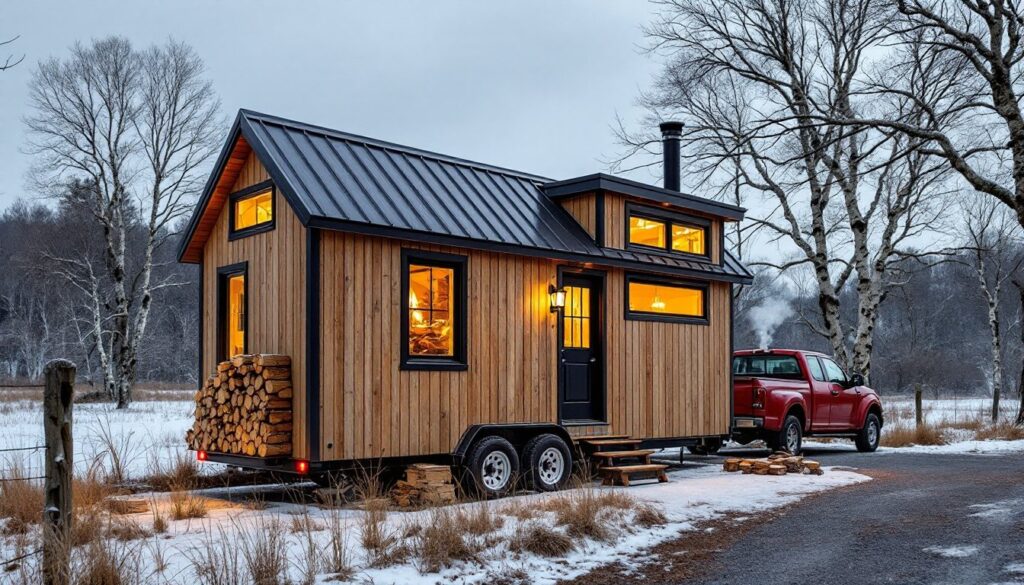
Heating options: A vented propane heater (like a direct-vent wall furnace) is the most common choice, but propane prices in Vermont can spike in winter. Budget $600–$1,200 per season for a well-insulated 200-square-foot space. Wood stoves (like the Cubic Mini or Dwarf models designed for tiny spaces) are romantic and tie into Vermont’s forestry culture, but they require daily tending, ash removal, and a proper Class A chimney installation, which runs $1,000–$2,000. Mini-split heat pumps work in Vermont if you choose a cold-climate model rated to -15°F or lower, but you’ll need backup heat for extreme cold snaps.
Moisture control: Tiny houses generate a lot of interior humidity from cooking, showering, and breathing. In winter, that moisture migrates toward cold surfaces and condenses, leading to mold and rot. Install a continuous exhaust fan (rated for at least 50 CFM) or an HRV/ERV (heat recovery ventilator) if you want to retain heat while venting moisture. Crack a window slightly during cooking or showering, yes, even in January.
Plumbing: Freeze protection is non-negotiable. Use PEX tubing for all water lines (it tolerates occasional freezing better than copper or CPVC). Insulate pipes with foam sleeves, and run them through interior walls or heated floor cavities when possible. For waste lines, pitch them aggressively (1/4″ per foot minimum) and consider heat trace cable in unheated areas. If you’re off-grid, a composting toilet eliminates the need for a black-water tank that can freeze.
Snow load: Vermont building code requires roofs to handle snow loads of 50–70 PSF depending on elevation. Tiny house roofs are small, but if you’re building on a trailer, the frame isn’t engineered for structural loads. Reinforce roof trusses with 2×6 or 2×8 rafters on 16″ centers, and use 3/4″ plywood or OSB sheathing. Metal roofing sheds snow faster than shingles, reducing accumulation. Contemporary real estate trends show increasing interest in climate-adapted small housing designs.
Tiny House Communities and Resources in Vermont
Vermont has a small but growing network of tiny house communities and supportive landowners. Songaia Cohousing in Berlin has explored tiny house integration, though it’s primarily a traditional cohousing community. Several private landowners in the Mad River Valley and Northeast Kingdom offer RV/tiny house parking on rural properties, often in exchange for caretaking, farm help, or modest rent.
Fireside Tiny Houses in Morrisville is a Vermont-based builder specializing in cold-climate designs. They understand local code requirements and can deliver turnkey units ready for year-round living. Jamaica Cottage Shop in South Londonderry sells post-and-beam kits and small cabin shells that can be finished as tiny houses on foundation.
For DIYers, the ReSOURCE salvage yard in Burlington stocks reclaimed lumber, windows, doors, and fixtures at a fraction of retail cost. Barter Builders is an informal network of Vermonters who trade labor and materials, worth tapping into if you’re willing to help on someone else’s project in exchange for skilled assistance on yours.
Online, the Vermont Tiny House Enthusiasts Facebook group is active and helpful. Members share land leads, zoning wins, builder reviews, and winter survival tips. The group sometimes organizes meetups and tiny house tours.
Local lumber yards like E.L. Smith in Barre and A. Johnson Company in Bristol can supply rough-sawn lumber milled from Vermont timber, often cheaper and higher quality than big-box stores. If you’re building, establishing a relationship with a local yard gets you access to advice, custom milling, and delivery.
Vermont’s Department of Housing and Community Development occasionally offers grants or loans for innovative housing, though tiny houses on wheels typically don’t qualify. If you’re building an ADU on foundation, check county and state housing resources.
Some inspiring examples of compact dwellings show how others have adapted tiny living to challenging climates. Also, if someone is still comparing housing options, Vermont’s unique blend of rural affordability and progressive zoning may tip the scales. For those seeking practical guidance, connecting with Vermont’s tight-knit DIY community often proves more valuable than any online forum. Publications like Fine Homebuilding regularly feature cold-climate construction details applicable to tiny house builds.
Vermont doesn’t make tiny house living easy, but it rewards preparation, honest communication with local officials, and a willingness to adapt. The state’s combination of affordable rural land, environmental values, and DIY culture creates real opportunities for those ready to trade square footage for freedom, and who don’t mind shoveling their roof a few times each winter.